Platform for the promotion of universal accessibility

Accessible mobility: experts call for greater involvement of people with disabilities in transport design

Blind man on a train platform following the tactile pavement indicator.

Experts and accessibility organizations are urging that people with disabilities play an active role in the design, evaluation, and improvement of mobility services, ensuring that solutions genuinely meet their needs. The call was made during the European event Advancing Accessibility in Transport, held in Dublin and organized by the European Accessibility Center, AccessibleEU.

Opening the event, Jesús Hernández Galán, director of AccessibleEU, stressed that accessibility must be embedded across every stage of the transport system—from infrastructure and vehicle planning to the development of digital tools and professional training. He emphasized that meaningful progress will only be achieved if public authorities, companies, universities, and civil society organizations work together in a coordinated way.

Participants explored international trends in accessible mobility, discussing technological innovation, interoperability, digital accessibility, and the challenges of cross-border travel.

They also agreed on the importance of strengthening strategic cooperation among operators, industry, and civil society.

The meeting included a dedicated session on the state of accessibility in Ireland, where authorities and service providers shared recent progress and future priorities. Speakers also highlighted the importance of incorporating the direct experiences of people with disabilities into decision making, ensuring that mobility solutions truly support autonomy and inclusion.

Source: Europa Press

A report exposes serious barriers to respecting the rights of persons with intellectual disabilities

Coworkers Discussing Work in the Office. One is a man and the other one is a woman with down syndrome.

Many European countries, despite having signed the United Nations Convention on the Rights of Persons with Disabilities, still deny persons with intellectual disabilities their rights, says the Inclusion Indicators report published by Inclusion Europe.

According to the report, 14 countries continue to remove the legal capacity of persons with intellectual disabilities, preventing them from making decisions about their own lives. A further 15 countries allow legal capacity to be partially removed without providing supported decision-making mechanisms.

Additionally, in 13 countries persons with intellectual disabilities may lose their right to vote when their legal capacity is withdrawn, and in 14 countries they are prevented from standing as candidates in elections.

Only 4 countries fully respect the right to make decisions with appropriate support, and just 5 countries have elected representatives with intellectual disabilities.

Another finding of the study is that institutionalisation remains widespread across Europe. At least 1.1 million persons with disabilities live in large, segregated institutions. Another 350,000 persons live in smaller care homes, 270,000 of whom are citizens of European Union Member States.

Furthermore, 37,000 persons with intellectual disabilities are placed in psychiatric hospitals. Although at least 7 countries have closed institutions this year, institutionalisation remains deeply entrenched.

Housing and support options for these individuals continue to be extremely limited, as do employment opportunities. Those working in protected employment programmes earn below the minimum wage.

Source: AccessibleEU

AccessibleEU celebrates its second anniversary and the EAA

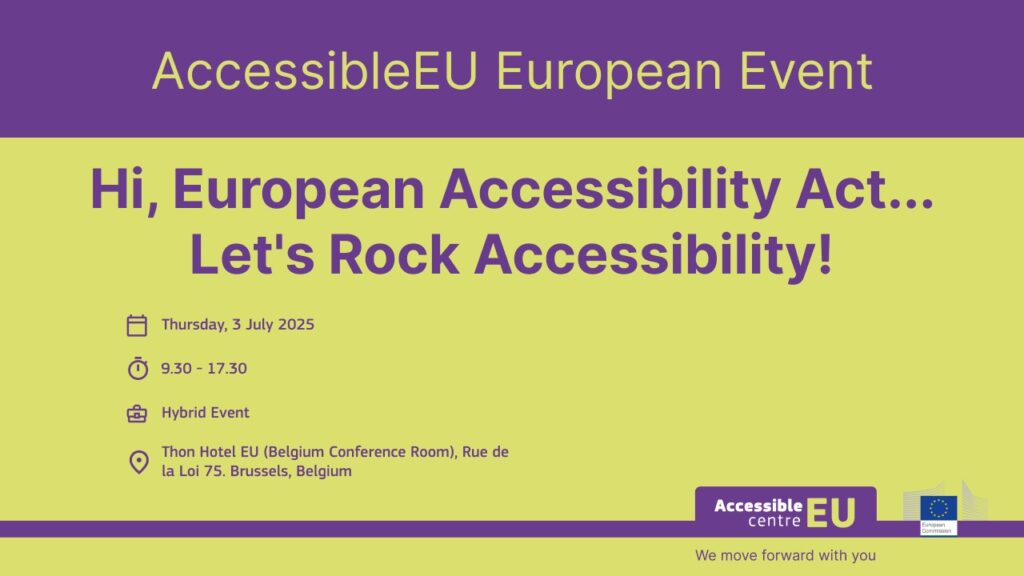
Banner with information about the July 3rd event

The European Accessibility Centre will hold a double celebration this July, marking its second anniversary and the entry into force of the European Accessibility Act, with a conference taking place in Brussels. The activity aims to provide an opportunity to reflect on progress made, share good practices, and prepare for the transformative changes the Act will bring.

It also aims to promote dialogue and showcase the results achieved to date. The goal is to ensure all stakeholders are prepared for the transformative impact of the Act and celebrate the momentum towards a European Union that benefits everyone. The event will be offered exclusively in English and in a hybrid format. It will also include captioning in English and International Sign.

Information and registration

But that’s not all. On July 1, the event How to improve accessibility of banking services will also take place in Brussels. It has been organised by AccessibleEU and the European Banking Union (EBU).

The conference aims to provide an opportunity to share experiences and best practices to make banking platforms more accessible.

Information and registration Source: AccessibleEU

AccessibAll and UEFA invite football fans with disabilities to complete a survey

View of a football stadium from the goalpost, full to capacity and with players on the pitch.

AccessibAll and UEFA are inviting persons with disabilities from different European countries to participate in a research project that seeks to learn about their experiences as football fans.

They are particularly keen to know about the experiences of disabled fans with existing barriers as well as about situations that may arise in stadiums that could hinder their enjoyment of matches.

The survey language is English. However, most internet browsers will be able to translate the questions automatically into participants’ chosen language (see AccessibAll’s website). Please feel free to complete the survey in your preferred language.

The survey will be open until midnight on 31 May 2025, and a detailed report on the findings will be published later in the year.

Source: Accessiball

Deadline for submitting works to Discapnet Awards for Accessible Technologies has been extended

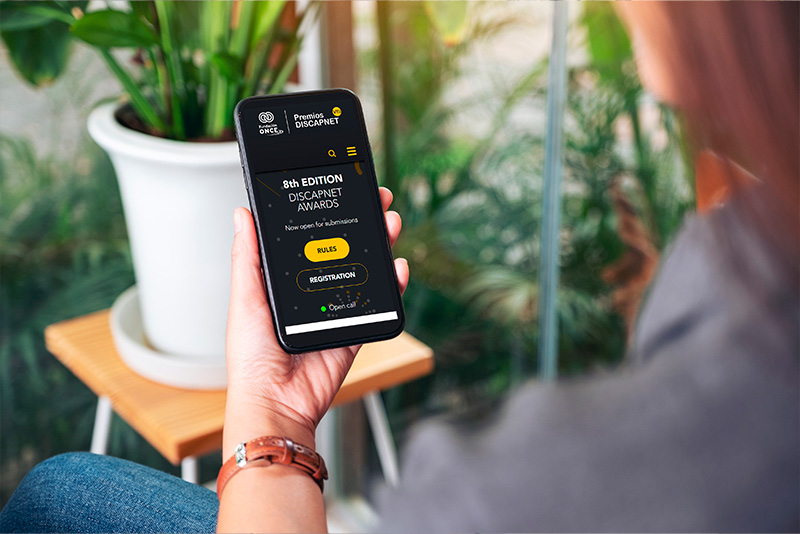
A person seeing the homepage of Discapnet Awards wesbite on a mobile device's display.

Fundación ONCE has extended the deadline for submitting works to Discapnet Awards for Accessible Technologies. Those interested in submitting their works can do so until May 31 by filling in the form corresponding to the category of their choosing available on the awards’ website: https://premios.discapnet.es/en/home

Discapnet Awards for Accessible Technologies recognize the best initiatives and actions in the field of Information and Communication Technologies (ICT) designed to improve the lives of people with disabilities, as well as institutions and organisations that have carried out continuous work in the field of accessible technology.

The awards are divided into four categories.

Category A will recognise the best available technology-related product or service designed to improve the lives of people with disabilities.

Category B prize will be awarded to the person, company, institution or organisation with an outstanding trajectory in working to improve accessibility to technology.

Category C recognises the best business venture project with a social impact that aims to improve the lives of people with disabilities through ICTs.

Category D prize will be awarded to the most prominent media outlet in disseminating information about accessible technology-related initiatives, projects, products and services.

As in the previous edition, winners of each category will receive a cash prize.

Categories A, B, C and D winners will receive € 5.000. Category C winner will receive € 15.000, which must be fully allocated to the development of the winning business venture.

Rules for the 8th edition of Discapnet Awards can be viewed in this link https://premios.discapnet.es/en/7th-edition#anclabases

Source: Fundación ONCE

Guidelines to make cultural events inclusive

People with raised hands at a public event. Gathering in concert hall

Accessibility remains to be a pending task in the world of music and entertainment. Many persons with disabilities still encounter difficulties to fully participate and enjoy concerts, sport events as well as other cultural and recreational activities becuase of the lack of accessibility.

The European Association of Service Providers for Persons with Disabilities (EASPD) has published the booklet Organising Cultural Events for all that provides practical and creative guidelines to help organisers, cultural institutions and policymakers ensure events and activities are accessible.

The booklet is part of the Revelland project, a collective initiative of artists, directors and event organizers, determined to make performing arts accessible to everyone.

The publication can be downloaded free of cost from EASPD website.

Source: EASPD
Go to top of the page.