

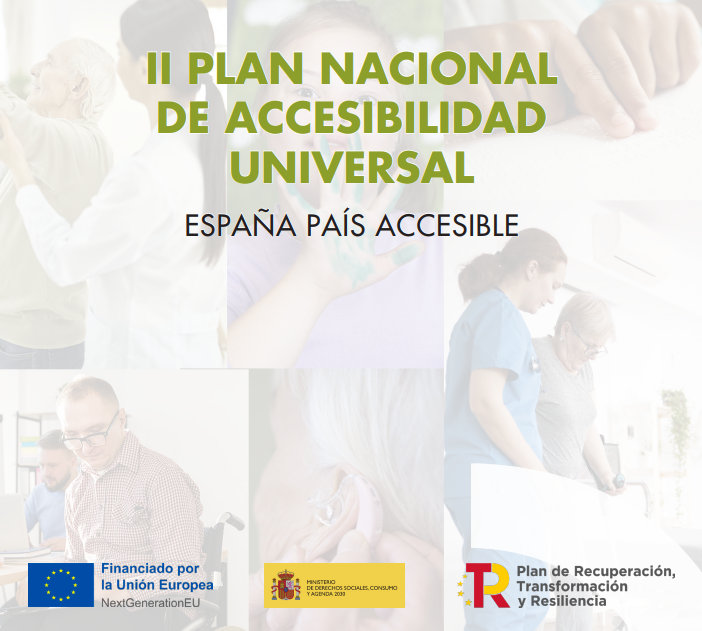
The II National Plan for Universal Accessibility is now available on the website of the Royal Board of Trustees.
This Plan was born with the aim of generating and strengthening the culture of accessibility within the General Administration of the State, so that services and public spaces are accessible to all citizens without exceptions.
The Ministry of Social Rights and Agenda 2030 presents the II National Universal Accessibility Plan. Spain Accessible Country, the roadmap that will guide the Spanish State in this matter over the coming years, to achieve the mandates of the International Convention on the Rights of Persons with Disabilities.
This Plan provides continuity to a political and budgetary commitment derived from the Transformation, Recovery and Resilience Plan, to make Europe more social, inclusive and accessible. And that has allowed us to allocate almost 200 million euros to transform our landscape, so that it is more practicable for all people without exceptions.
These funds have been allocated to comply with the Law, to repair and expand rights, in key areas such as access to public services, housing, education, health or culture.
Extensive information by consulting the II National Accessibility Plan.
Source: ROYAL BOARD ON DISABILITY
 Turespaña, in collaboration with some autonomies, has invested nearly five million euros in the last five years to promote and improve the experience of tourists who have a disability and thus “facilitate access to everyone.”
During the celebration of the 44th edition of the Fitur International Tourism Fair, held this week in Madrid, the tourism sector has highlighted the need to facilitate tourism for everyone. In particular, participating companies have focused on accessibility to make “tourism accessible to all.”
In the third quarter of 2023, a total of 60.6 million trips were made, according to the National Institute of Statistics (INE). Specifically, the destinations most visited by Spaniards were the national territories, with Andalusia in the lead, with more than 10.8 million visits, followed by Catalonia, with 7.7 million and the Valencian Community, which received 6.8 millions of tourists.
Accessibility in national destinations has been promoted by the collaboration between the destinations and Turespaña. Specifically, the tourism promotion body invested, in collaboration with the autonomous communities, more than five million euros to promote the accessibility of the territories, as well as the creation of specialized consultation portals.
Regarding the promotion of accessible tourism, Turespaña sources told Servimedia that “different lines of action have been developed, such as adapting monuments that were not accessible, as well as in inns.”
Regarding the creation of specialized consultation portals, the same sources highlighted that work has been done to improve the existing ones, providing greater detail and information to “make tourism easier for people with disabilities”, as well as the creation of said pages. website in those autonomies that did not yet have their own.
The autonomous communities also developed plans to facilitate access to tourism for this group, as well as the adaptation of different areas such as transportation or access to establishments.
An example of this is Catalonia, which has allocated more than 10.5 million euros in the last four years to adapt some metro stations that until then were not accessible, such as Plaza España, a large urban center and a point on the metro network. of the city of Barcelona, which has been a center of great demand due to its importance in the city’s public transport.
Source:
Turespaña, in collaboration with some autonomies, has invested nearly five million euros in the last five years to promote and improve the experience of tourists who have a disability and thus “facilitate access to everyone.”
During the celebration of the 44th edition of the Fitur International Tourism Fair, held this week in Madrid, the tourism sector has highlighted the need to facilitate tourism for everyone. In particular, participating companies have focused on accessibility to make “tourism accessible to all.”
In the third quarter of 2023, a total of 60.6 million trips were made, according to the National Institute of Statistics (INE). Specifically, the destinations most visited by Spaniards were the national territories, with Andalusia in the lead, with more than 10.8 million visits, followed by Catalonia, with 7.7 million and the Valencian Community, which received 6.8 millions of tourists.
Accessibility in national destinations has been promoted by the collaboration between the destinations and Turespaña. Specifically, the tourism promotion body invested, in collaboration with the autonomous communities, more than five million euros to promote the accessibility of the territories, as well as the creation of specialized consultation portals.
Regarding the promotion of accessible tourism, Turespaña sources told Servimedia that “different lines of action have been developed, such as adapting monuments that were not accessible, as well as in inns.”
Regarding the creation of specialized consultation portals, the same sources highlighted that work has been done to improve the existing ones, providing greater detail and information to “make tourism easier for people with disabilities”, as well as the creation of said pages. website in those autonomies that did not yet have their own.
The autonomous communities also developed plans to facilitate access to tourism for this group, as well as the adaptation of different areas such as transportation or access to establishments.
An example of this is Catalonia, which has allocated more than 10.5 million euros in the last four years to adapt some metro stations that until then were not accessible, such as Plaza España, a large urban center and a point on the metro network. of the city of Barcelona, which has been a center of great demand due to its importance in the city’s public transport.
Source: 
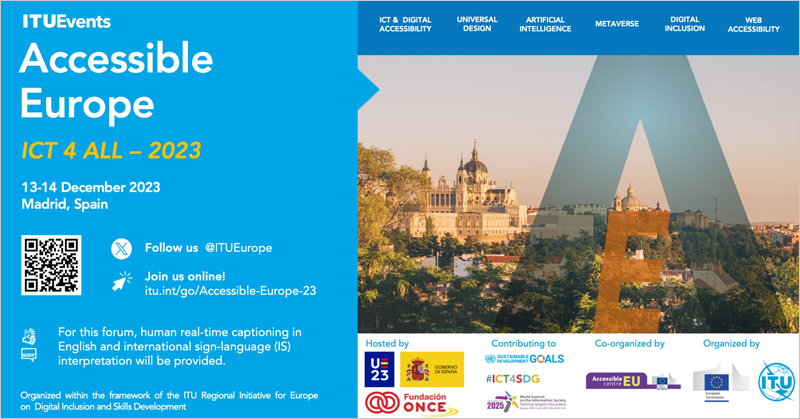 Fundación ONCE hosted in Madrid the conference organized by the International Telecommunications Union, the European Commission and AccessibleEU in which the Government committed to intensifying digital policies on social inclusion in a way that guarantees digital accessibility for people with disabilities. .
The opening ceremony was attended by Rosa Martínez, Secretary of State for Social Rights and Agenda 2030; María González Veracruz, Secretary of State for Telecommunications and Digital Infrastructure, and Miguel Carballeda, president of the ONCE Social Group.
In their speech, both Government officials committed to the objective of implementing accessible digital policies. “It is vital for the entire society and particularly for people with disabilities,” said González Veracruz. “That commitment is key,” she stressed, “if not, the gap that is generated is exponential.”
For this reason, she opted for a humanist digitalization, which puts people at the center. “My greatest commitment is to continue working so that the objectives set by Europe are a reality for the entire population,” she concluded.
For her part, Rosa Martínez first recognized the “solid work” of the ONCE Foundation, which has managed to ensure that the European Accessibility Center is led from Spain, which, she emphasized, “is a source of pride.”
For this reason, and in line with what was expressed by María González, the Secretary of State for Social Rights affirmed that the Executive will continue working to make digitalization “an opportunity” and not a brake for people with disabilities, who often see how The barriers they encounter in the health, work or leisure fields “are reproduced in the access and use of digital.”
From this perspective, he committed to promoting “public policies supported by science” that ensure that in the acceleration that the digital world is experiencing “no one is left out or becomes a second-class citizen” and that they offer “certainty and security.” to the entire population.
Because, she concluded, “digitalization opens up enormous opportunities, but we must take care of its risks by putting people at the center and ensuring that it does not widen gaps or generate new inequalities.”
Finally, Miguel Carballeda picked up the Government’s baton to work so that digitalization is an opportunity and not a barrier for people with disabilities. “They have committed themselves and I thank them,” he responded.
It is a responsibility to be the accessibility machine,” continued the president of the ONCE Social Group, who insisted on the importance of maintaining this position and contributing to making “a better country and a Europe for all citizens.” “Spain, Europe and people with disabilities deserve it. We can be an example for the rest of the world,” he concluded.
Source:
Fundación ONCE hosted in Madrid the conference organized by the International Telecommunications Union, the European Commission and AccessibleEU in which the Government committed to intensifying digital policies on social inclusion in a way that guarantees digital accessibility for people with disabilities. .
The opening ceremony was attended by Rosa Martínez, Secretary of State for Social Rights and Agenda 2030; María González Veracruz, Secretary of State for Telecommunications and Digital Infrastructure, and Miguel Carballeda, president of the ONCE Social Group.
In their speech, both Government officials committed to the objective of implementing accessible digital policies. “It is vital for the entire society and particularly for people with disabilities,” said González Veracruz. “That commitment is key,” she stressed, “if not, the gap that is generated is exponential.”
For this reason, she opted for a humanist digitalization, which puts people at the center. “My greatest commitment is to continue working so that the objectives set by Europe are a reality for the entire population,” she concluded.
For her part, Rosa Martínez first recognized the “solid work” of the ONCE Foundation, which has managed to ensure that the European Accessibility Center is led from Spain, which, she emphasized, “is a source of pride.”
For this reason, and in line with what was expressed by María González, the Secretary of State for Social Rights affirmed that the Executive will continue working to make digitalization “an opportunity” and not a brake for people with disabilities, who often see how The barriers they encounter in the health, work or leisure fields “are reproduced in the access and use of digital.”
From this perspective, he committed to promoting “public policies supported by science” that ensure that in the acceleration that the digital world is experiencing “no one is left out or becomes a second-class citizen” and that they offer “certainty and security.” to the entire population.
Because, she concluded, “digitalization opens up enormous opportunities, but we must take care of its risks by putting people at the center and ensuring that it does not widen gaps or generate new inequalities.”
Finally, Miguel Carballeda picked up the Government’s baton to work so that digitalization is an opportunity and not a barrier for people with disabilities. “They have committed themselves and I thank them,” he responded.
It is a responsibility to be the accessibility machine,” continued the president of the ONCE Social Group, who insisted on the importance of maintaining this position and contributing to making “a better country and a Europe for all citizens.” “Spain, Europe and people with disabilities deserve it. We can be an example for the rest of the world,” he concluded.
Source:  Inserta Innovación, an entity dependent on the ONCE Foundation, is working to ensure that new technologies take disability into account, an example of this is the