ONCE Foundation is looking for ‘startups’ that work in the field of disabilities or older people and that have some experience in the market to help them address their main growth challenges and thus improve their quality of life.
To make this possible, the entity presents a renewed version of its acceleration program, which from now on will be called growth, and which aims to support the evolution of the business fabric in the field of disability and older people . The initiative will be carried out in collaboration with PwC.
“At Fundación ONCE we have been promoting the acceleration of projects and startups related to disability for years. What previous editions have taught us is that these projects, in addition to collaborating in improving the quality of life of people with disabilities, allow us to generate business models and solutions that provide innovation, talent and improvements to the entire society,” explains Jesús Hernández, director of Accessibility and Innovation at Fundación ONCE. “With the launch of this growth program,” he continues, “we want to continue being a key player, an engine of growth in the entrepreneurial ecosystem of disabilities and older people.”
From this perspective, the ONCE Foundation Business Growth Program looks for companies in the field of disabilities or older people that have a certain history in the market and are in a growth phase to help them at this stage.
The program will have a team of growth experts who will advise companies through the development of specific projects tailored to their needs. It will focus, therefore, on finding solutions to the barriers that prevent them from growing more quickly. Companies will thus have a specific and personalized service that resolves any need related to the business, the structure of the company or its capital.
The growth program will have an estimated duration of between 8 and 12 weeks, although it may be increased for some more time if considered necessary.
The deadline to request participation in this business growth initiative ends on March 8 and those interested in submitting applications can do so now through the following link https://www.fundaciononce.es/es/programa-de -foundation-growth-on…
The ONCE Foundation Business Acceleration Program, which is the seed of growth, has supported the promotion of more than fifteen innovative projects capable of impacting the improvement of the quality of life of people with disabilities in their four editions. These include, for example, Showee – a company that designs and manufactures eco-smart and accessible shower columns that transform the showering experience for people with reduced mobility – or Depencare – a service company that seeks to guarantee quality care and access to caregivers in the most depopulated areas of Spanish territory -.
Source: ONCE Foundation


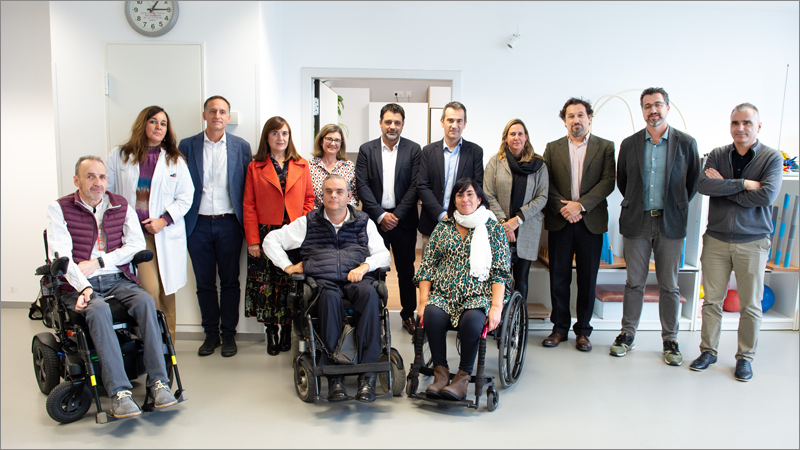 In collaboration with the ONCE Foundation, the National Hospital for Paraplegics of Toledo has launched a 40 square meter apartment completely automated. This apartment will function to train patients for daily living in housing when they leave the center, and even if they will live alone.
The technological equipment has been carried out by collaborators who have been involved in the project, among others Ugari Geriátrica, Simon, Samsung, Qvadis, Adom, Fama, Pardo and Carpintería ELIT.
The objective of this initiative has been to create a functional apartment of reduced dimensions to show that you can have an adapted home without needing many square meters.
The apartment is equipped with control systems, using both products available on the conventional market and other specific ones that allow access to different elements of the home for people with great motor limitations.
This environment provides a space for training in basic and instrumental activities of daily life, is a showcase of accessibility solutions in the home that enable the independence of people at home and creates an environment for conducting evidence-based research. related to independent living.
Regarding the technology included in this apartment, the lighting and home automation systems from Simon, the smart phone from Qvadis, and the kitchen appliances and television from Samsung stand out, which can be controlled through the company’s application.
Likewise, the apartment has countertop lifting systems and height-adjustable toilets thanks to Ugari Geriátrica, while the ceiling crane, the shower channel and the home automation systems have been provided by Adom. For its part, Fama has provided the sofa and the auxiliary tables in the living room; Pardo has given up the bed and Carpintería Elit has installed the kitchen furniture.
In the selection of each of the elements, not only functionality, but also its aesthetic component has been taken into account.
Source: CASADOMO
In collaboration with the ONCE Foundation, the National Hospital for Paraplegics of Toledo has launched a 40 square meter apartment completely automated. This apartment will function to train patients for daily living in housing when they leave the center, and even if they will live alone.
The technological equipment has been carried out by collaborators who have been involved in the project, among others Ugari Geriátrica, Simon, Samsung, Qvadis, Adom, Fama, Pardo and Carpintería ELIT.
The objective of this initiative has been to create a functional apartment of reduced dimensions to show that you can have an adapted home without needing many square meters.
The apartment is equipped with control systems, using both products available on the conventional market and other specific ones that allow access to different elements of the home for people with great motor limitations.
This environment provides a space for training in basic and instrumental activities of daily life, is a showcase of accessibility solutions in the home that enable the independence of people at home and creates an environment for conducting evidence-based research. related to independent living.
Regarding the technology included in this apartment, the lighting and home automation systems from Simon, the smart phone from Qvadis, and the kitchen appliances and television from Samsung stand out, which can be controlled through the company’s application.
Likewise, the apartment has countertop lifting systems and height-adjustable toilets thanks to Ugari Geriátrica, while the ceiling crane, the shower channel and the home automation systems have been provided by Adom. For its part, Fama has provided the sofa and the auxiliary tables in the living room; Pardo has given up the bed and Carpintería Elit has installed the kitchen furniture.
In the selection of each of the elements, not only functionality, but also its aesthetic component has been taken into account.
Source: CASADOMO